| Updated: 8 June, 2023 |
|

|
 |
Getting Started
1. Introduction2. Switching to GNU/Linux
3. Getting openSUSE
4. Installation
The Fundamentals
5. KDE Plasma Workspace6. Apps for Common Tasks
7. Security and Root
8. Terminal
9. Admin. Settings (YaST)
10. Installing Software
11. Software Repositories
Setup
12. MS Windows Interop13. Multimedia Codecs
14. Graphics Drivers
15. Wifi
Appendix
A: Help and DocsB: Games
C. Under the Hood
D. History and Background
E: Getting Involved
GNU Free Documentation License
Appendix B: Games
Not all major, mainstream games run natively on GNU/Linux, but there are still plenty of gaming options.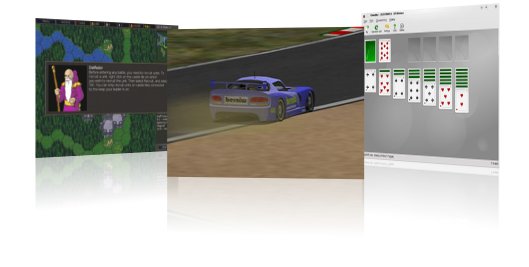
B.1 Native GNU/Linux Games
B.1.1 openSUSE Build Service Games Repository
Some games are included in the official openSUSE repositories, but the Games repository on the openSUSE Build Service includes a lot more games. You can easily add this repository via the list of Community Repositories as described in the chapter about Software RepositoriesOr add the games repository using the command line:
zypper addrepo -f http://download.opensuse.org/repositories/games/openSUSE_Leap_15.5/ games
B.1.2 Steam Gaming Platform and Store
The Steam gaming platform and store is available for GNU/Linux.You can find packages of it hereB.1.3 Desura
The Desura distribution service for gamers provides easy access to non-free indie games, see:http://www.desura.com
B.1.4 Other GNU/Linux Gaming Resources
Linux Game Publishing buy titles and port them to GNU/Linux, see:http://www.linuxgamepublishing.com
Lots and lots more of free and non-free games exist - some small and simple, others quite big, and many very good. Check out some of these sites:
http://www.tuxgames.com/
http://www.penguspy.com/
http://www.lgdb.org/
http://www.linuxgamingworld.com/
B.2 Running MS Windows Games
Some software available for GNU/Linux allows you to run games developed for MS Windows on GNU/Linux - ease of use and success rate may vary - however, the more popular the game, the more likely it is to be supported.B.2.1 Wine
Wine (Wine Is Not an Emulator) is the first option, it's free software installable via the package manager. See the Wine app database for information on running individual games:http://appdb.winehq.org/appbrowse.php?iCatId=2
Wine is a command line application, the syntax is:
wine /path/to/setup.exe
B.2.2 PlayOnLinux
PlayOnLinux is based on Wine and lets you easily install and use (some) MS Windows Games. You can find packages of PlayOnLinux in the above mentioned Games repository.B.2.3 CrossOver Games
A second option is CrossOver Games which is an effort based on Wine. See:https://www.codeweavers.com/products/cxgames/
B.3 Emulators
Numerous emulators exist, making it possible to run many old classic games of other platforms on GNU/Linux. For example:- Amiga (UAE)
- Arcade (MAME)
- Atari (Stella, Steem)
- Commodore 64/128 (VICE)
- MS DOS (DOSBox, DOSEMU)
- Nintendo (infones, bsnes, nestopia)
- Play Station (pcsx, pcsx2)
 |
Usually you can only do this legally, if you own the original hardware/have a licence for it. |
 |
 |
Send your comments via e-mail to admin [at] opensuse-guide.org